EXTRAORDINARY HOUSE
MEMORANDUM TO MEMBERS
Reference: MM/2026/007
Date: 1 August 2026
From: The Secretary
To: All Members, Former Members, Descendants, Insurers and Persons Who Remember the Pudding
Subject: Preliminary Enquiry into the Loss of the Former House
During the reconstruction of The Archive, the Committee has reopened the question of how the former Extraordinary House was destroyed.
The accepted account is that the former premises were lost during the Blitz.
The surviving records establish that an air raid was taking place, that fires were reported in the surrounding district and that the House did not survive the night.
They do not establish that enemy action started the fire.
The governing distinction is therefore as follows:
The former House was lost during the Blitz. Whether it was lost to the Blitz remains disputed.
For many years, members attributed the destruction to an enemy incendiary device. This explanation was repeated in later correspondence, accepted in several obituaries and referred to whenever the Committee required an adequate reason for the absence of earlier records.
It remains possible.
It is not, however, the only explanation preserved within the House.
A less dignified account concerns dinner.
According to several member recollections, members and staff had assembled in the lower dining room during the air raid. Whether they were sheltering there, dining there or sheltering from the interruption of dinner has not been determined.
The black-out curtains had been drawn.
Dinner continued.
At some point, a pudding was produced.
Accounts disagree as to whether it was:
- Christmas pudding;
- crêpes Suzette;
- cherries jubilee;
- an improvised steamed pudding;
- or something described by the kitchen as “the best that could be managed under present conditions”.
The surviving menu does not resolve the question. The original dessert appears to have been crossed out and replaced by hand with the words:
SOMETHING WARM
The ordinary spirit used for culinary purposes had apparently run out.
A bottle was therefore obtained from the cellar.
The bottle had no surviving commercial label. One account describes it as emergency wartime brandy. Another suggests that it had been supplied by a member possessing some connection with military procurement. The closeness of that connection varies considerably according to the person telling the story.
The Cellar Book may contain a corresponding entry:
BRANDY — EMERGENCY — NOT FOR ORDINARY USE
The meaning of “ordinary use” was not defined.
An attempt was then made to flambé the pudding.
Witnesses who later described the incident agreed on very little. Several maintained that the resulting flame was considerably larger than the pudding. One recalled that it appeared blue before becoming white. Another stated that it was visible through or around the black-out curtains.
At least one member is said to have mistaken it for an enemy incendiary device.
This may explain the delay in recognising that the principal danger was already inside the dining room.
The House subsequently caught fire and was destroyed while the air raid remained in progress. The loss was therefore recorded as Blitz damage without any final determination of what first ignited the building.
The surviving Fire Brigade material records severe internal fire damage. No confirmed bomb crater is identified, and no surviving entry records the recovery of fragments from an incendiary device.
One page of the report is missing.
The Committee does not regard the absence of that page as proof of concealment. Pages have disappeared from the House records for reasons including fire, damp, discretion, carelessness, unpaid bills and the borrowing habits of members.
Nevertheless, its absence is inconvenient.
The insurers appear to have raised similar concerns. Surviving correspondence asks why the fire seemed to have begun inside the dining room shortly before the nearest reported bomb fell.
The answer supplied on behalf of the House has not survived.
Nor has the final response from the insurers.
The matter is complicated further by evidence that several of the rarest wines in the House cellar had been removed shortly before the incident.
The missing bottles appear to have included old Madeira, pre-war claret and a quantity of vintage port that the Committee had repeatedly refused to open on the ground that no surviving member was considered sufficiently important.
The Treasurer described their removal as:
ROUTINE WARTIME SAFEGUARDING
No surviving record identifies:
- who authorised the removal;
- who selected the bottles;
- who transported them;
- where they were taken;
- whether any subsequently returned;
- or why routine safeguarding was confined almost entirely to the most valuable bins.
Less distinguished wines remained in the cellar.
So did the emergency wartime brandy.
The Committee recognises three possible interpretations:
- The wines were removed as a sensible precaution during wartime.
- The wines were taken without proper authority.
- Somebody knew that the House was in greater danger from dinner than had been disclosed to the general membership.
No conclusion has been reached.
The absence of any later record concerning the safeguarded wines has caused the Committee to question whether they were protected from the fire or merely from the other members.
The former cook denied preparing a flambéed dessert that evening. The cook further maintained that no responsible member of the kitchen staff would have permitted that particular bottle to be used near a naked flame.
The phrase “responsible member of the kitchen staff” may prove material.
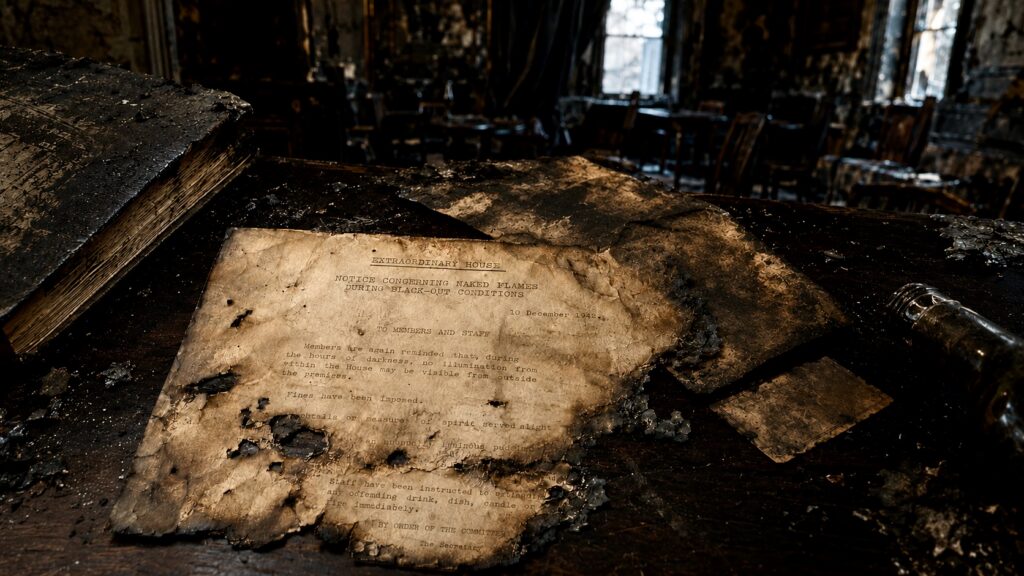
The Archive has also recovered a copy of the House’s wartime NOTICE CONCERNING NAKED FLAMES DURING BLACK-OUT CONDITIONS.
The notice records that the House had already been fined on several occasions for infringements of the lighting restrictions and had been warned that a further offence might result in imprisonment.
It prohibited throughout the House:
- cocktails or measures of spirit served alight;
- brandy, rum or other spirits ignited over a pudding;
- dishes flambéed at the table;
- candles, tapers and portable naked lights;
- ordinary fires in grates, hearths and fireplaces;
- and any entertainment, experiment, wager or demonstration involving the deliberate ignition of food or drink.
The notice specifically warned that the description of an infringement as “an unusually luminous pudding” would not be accepted as an excuse and might, under rationing conditions, invite further enquiries concerning the ingredients.
It also authorised staff to extinguish any offending refreshment without first obtaining the permission of the member intending to consume it.
The Committee has not established whether this authority was exercised on the night of the fire.
The original notice is badly burned.
Its upper portion remains legible, but its edges and lower sections were severely damaged in the destruction of the former House. Further unnecessary handling is therefore considered inadvisable.
For reasons of preservation and legibility, a reprint of the NOTICE CONCERNING NAKED FLAMES DURING BLACK-OUT CONDITIONS will be added to The Archive alongside the photographic record of the surviving original.
The condition of the original is not regarded as proof that the prohibited pudding caused the fire.
It is, however, an irony which the Committee has been unable to overlook.
The existence of the notice establishes that the Committee had anticipated the danger posed by members setting fire to refreshments during black-out conditions.
It does not establish that anybody obeyed it.
One surviving member later recalled that the pudding rose “like the wrath of God”. The evidential value of this statement is limited by his admission that copious quantities of alcohol had already been consumed.
He was unable to identify the pudding, the person responsible for pouring the spirit or the precise location from which he observed the flame.
He remained certain that it was an excellent dinner.
The Committee has therefore opened a preliminary enquiry into the following questions:
- Did an enemy device strike the former House?
- Did the fire begin within the lower dining room?
- What was served for pudding?
- Who obtained the emergency bottle?
- What did the bottle contain?
- Who attempted to ignite it?
- Why had the rarest wines been removed from the cellar?
- Who determined which bottles required safeguarding?
- What became of the safeguarded wines?
- Why was the emergency brandy left behind?
- What became of the missing page of the Fire Brigade report?
- Why did the insurers question the official account?
- Why was a prohibition on setting fire to food and drink considered necessary?
- Why did the prohibition fail to survive the fire in a more legible condition?
Members, former members, descendants and former staff are invited to submit relevant recollections or documents to The Archive.
Particular interest attaches to:
- cellar books;
- bin labels;
- wine merchants’ accounts;
- lists of bottles removed for wartime safeguarding;
- menus and kitchen records;
- insurance correspondence;
- fire and civil-defence reports;
- black-out infringement notices;
- Committee notices concerning naked flames;
- private letters;
- household accounts;
- witness statements;
- recipes;
- and any explanation for the phrase “not for ordinary use”.
No bottle believed to contain the emergency spirit should be opened, sampled, transported by public conveyance or brought into the present offices of the House.
The Committee’s interim position is:
The House accepts that the former premises were destroyed during enemy action. It does not accept that the dessert constituted enemy action, irrespective of where the brandy originated.
This enquiry is not intended to diminish the seriousness of the Blitz, the destruction experienced across London or the possibility that the House was struck by an enemy device.
It is intended only to determine whether the former House required assistance from the Luftwaffe in burning down.
Further records will be released as they are examined.
Until then, members are asked not to repeat the flambé account as established fact, particularly in the presence of descendants of the Treasurer, the cook, the insurers or anyone connected with military procurement.
They are also asked not to open any bottle matching the description of the missing wines without first notifying the Archivist.
By order of the Committee
The Secretary
Extraordinary House
The House was lost during the Blitz. Its finest wines had already left. The pudding remains under investigation.
Recent Comments