EXTRAORDINARY HOUSE
MEMORANDUM TO MEMBERS
Reference: MM/2026/006
Date: 1 August 2026
From: The Secretary
To: All Members, Former Members and Persons Able to Remember Why They Entered the Room
Subject: Member Recollections and the Age of the House
Members will be familiar with the longstanding assertion that Extraordinary House is the oldest members’ club in London.
The Committee has never found sufficient evidence to prove this claim.
It has found considerably more evidence that members have been making it for a very long time.
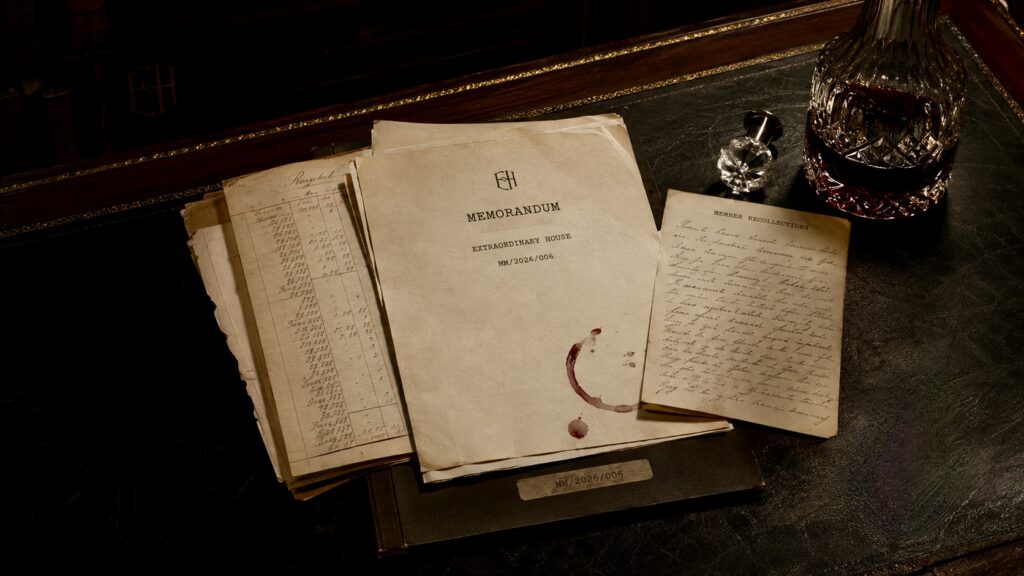
During the reconstruction of The Archive, the Secretary has begun collecting personal recollections concerning the origins, customs and former premises of the House. These accounts have come from surviving members, former members, descendants, household staff and persons who remember being told something important by somebody now dead.
Taken together, they suggest that Extraordinary House may have existed considerably earlier than the surviving written record indicates.
Unfortunately, every account so far examined was related after copious quantities of alcohol had been consumed.
One former member recalled being told that the House was already old during the reign of Queen Anne. He received this information from his grandfather over port after dinner. His grandfather had heard it from an uncle during the consumption of a considerable quantity of claret at the House.
The identity of the uncle remains disputed, as does the quantity of claret.
Another recollection places an Extraordinary dining society in London during the late seventeenth century. The account was written on the reverse of a wine merchant’s bill and concludes with the words:
We were here before the others.
The handwriting deteriorates sharply thereafter.
A third tradition maintains that the House began when several gentlemen were refused further service elsewhere and resolved to establish an institution in which no such restriction would apply. The Committee regards this as historically plausible but constitutionally unhelpful.
Other accounts refer to:
- an inaugural dinner that continued for three days;
- an early Treasurer who accepted Madeira in settlement of subscriptions;
- a House rule permitting no business to be discussed before the second bottle;
- a Chairman who remained in office for eleven years because nobody wished to wake him;
- a membership book stored beneath the Burgundy and lost during an attempt to improve access to the Burgundy;
- an eighteenth-century portrait whose sitter was identified only as “the member who ordered another”;
- and a founding minute purportedly signed by six gentlemen, although two signatures may be wine stains.
The Committee must therefore distinguish between three separate propositions:
- Extraordinary House is the oldest members’ club in London;
- members of Extraordinary House have always believed it to be the oldest members’ club in London; and
- members of Extraordinary House have repeatedly asserted the fact after copious quantities of alcohol had been consumed.
Only the third proposition can presently be established beyond reasonable doubt.
The absence of conclusive evidence should not, however, be mistaken for evidence that the House is recent. Records may have been lost through fire, relocation, discretion, unpaid storage charges and the repeated use of important papers to steady tables.
The institutional distinction between The Extraordinary Club and Extraordinary House, presently under separate examination, may also have obscured the record. Earlier references to the Club, the House, the Society, the Dining Room or simply “the usual place” may concern the same institution without employing its present name.
The Committee has therefore adopted the following interim position:
Extraordinary House is believed by its members to be the oldest members’ club in London, although the House has so far been unable to prove it to the satisfaction of historians, insurers or persons who were not present after dinner.
Members are invited to submit further recollections, papers or inherited accounts concerning the age of the House. Particular value will be placed upon material that:
- identifies a person, place or approximate date;
- can be traced through more than one generation;
- was recorded before the present reconstruction began;
- does not depend entirely upon what one gentleman remembered another gentleman saying after dinner;
- or survives in a form other than a wine merchant’s account.
Accounts related following the consumption of copious quantities of alcohol will not be excluded. To do so would remove almost the entire oral history of the institution.
Members should, however, identify the beverage where known. The Archivist has observed that recollections involving port tend to place the foundation earlier than those involving whisky, while accounts produced after Champagne frequently concern events that did not occur at all.
Claret appears to preserve dates reasonably well but greatly improves the social standing of everyone concerned.
No member should embellish an inherited story merely to assist the House in establishing its antiquity. If an account already contains a disputed duke, a missing portrait, an unpaid bill and a fire, it is probably sufficient.
The Committee would be particularly interested in evidence predating the better-documented London clubs. It would be equally interested in discovering why every person claiming to possess such evidence becomes unavailable when asked to produce it.
Until documentary proof is recovered, the House will not present its claim to antiquity as settled historical fact.
It will continue to observe that Extraordinary House may be the oldest members’ club in London, that generations of members have believed it to be so and that nobody has yet proved otherwise to the satisfaction of the Committee.
By order of the Committee
The Secretary
Extraordinary House
Possibly London’s oldest members’ club. Certainly among its least adequately documented.
Recent Comments